 Psychology - Body Language
Crossed arms are the most famous gesture in all of body language — and the most misread. Does it mean someone's shutting you out, disagreeing, hiding something, or just cold? The honest answer is "it depends," and knowing what it depends on is the difference between reading people and stereotyping them. Here's how to decode defensive and closed body language properly.
Key takeaways
- Crossed arms are a closed, self-protective cue — not proof.
- Read them alongside other signals and the situation.
- Cold or simple comfort can explain the same posture.
What does crossing your arms actually mean?
Crossed arms are a barrier gesture: the body puts a physical shield between a person and something they find uncomfortable. That discomfort can be emotional (disagreement, defensiveness, feeling exposed) or completely mundane (a cold room, no armrests, or simply a comfortable resting position). The gesture points to "closed off" — but it doesn't, by itself, tell you why.
The main defensive / closed cues
- Crossed arms — the classic barrier; stronger if the fists are clenched or the arms grip tightly.
- Crossed legs angled away from you, or ankles locked under the chair.
- Object barriers — holding a bag, cup, notebook or phone across the chest, or positioning a laptop like a shield.
- Leaning or turning away — the torso rotates so it no longer faces you.
- Reduced eye contact and a lowered or tucked chin.
- Self-soothing touches — rubbing the neck, arms or hands, a sign of stress rather than aggression.
- Minimising space — pulling the limbs in, making the body small (often anxiety or low confidence).
Defensive vs. angry vs. anxious
Closed gestures can spring from different states, and the accompanying cues tell them apart:
- Defensive / disagreeing: firm crossed arms, tight lips, leaning back, steady but cool eye contact.
- Angry: add a lowered, drawn-together brow, a clenched jaw, a hard stare, and a forward lean.
- Anxious / uncomfortable: add self-soothing touches, fidgeting, a shrinking posture, and gaze avoidance.
How to respond when you see closed body language
Closed cues are feedback, not a wall. If you notice someone shutting down, you can shift the dynamic: warm up your own nonverbal signals (open posture, softer tone), give them more space, ask an open question, or address the concern directly. Watch for the barrier to drop — arms uncrossing and the torso squaring back to you means you've re-opened the conversation.
Master gesture-reading with the app
Closed cues only make sense alongside everything else the body is doing. Psychology - Body Language teaches you the full vocabulary:
- Download the app free on the App Store.
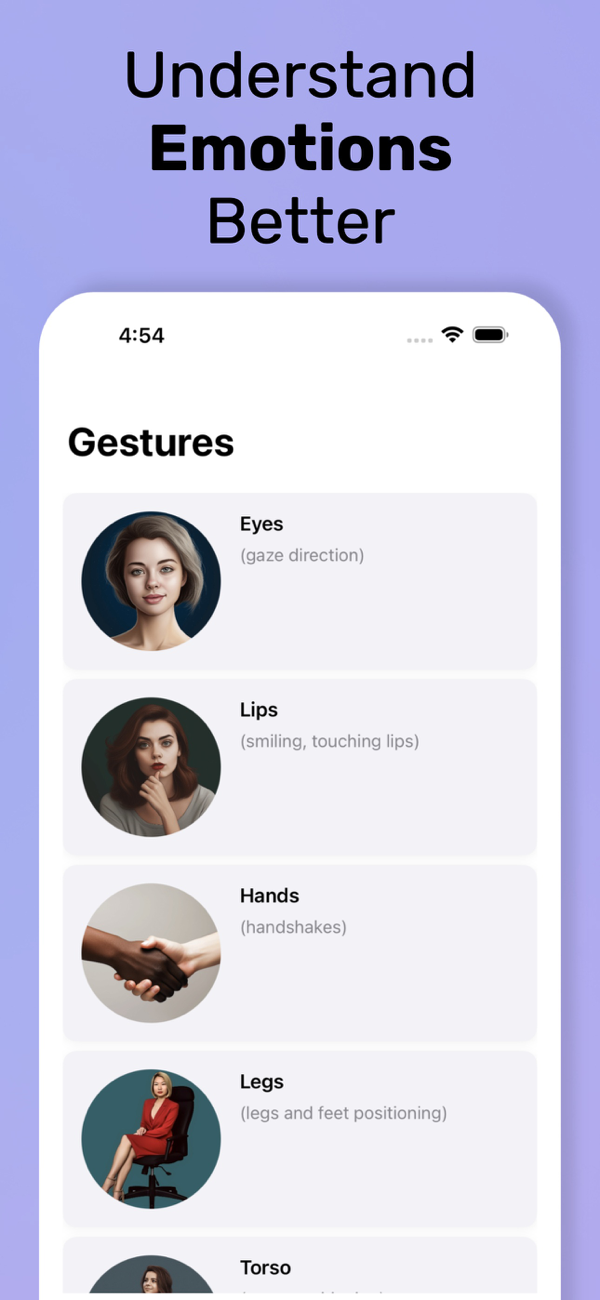
- Study gestures by body area — Hands, Legs, Torso and more — including barrier and defensive cues, each with an Expert Tip and the Deep Science behind it.
- Learn to pair them with facial microexpressions so you can tell defensiveness from anger from anxiety.
- Lock it in with quizzes that show a scenario and ask what the posture signals.
The bottom line
Crossed arms and other closed gestures signal a barrier — but only the surrounding cluster and context tell you whether it's disagreement, anger, anxiety or a chilly room. Read them the same way you read everything else: baseline, cluster, context. More on that in how to read body language.