 Psychology - Body Language
Researchers estimate that the majority of emotional meaning in a conversation is carried nonverbally — through posture, gesture, face and tone — not through the words themselves. That's why two people can say the exact same sentence and mean opposite things. Learning to read body language is learning to hear that second, silent conversation. Here is the complete method, from the ground rules to reading each part of the body.
Key takeaways
- Read every cue against the person's normal baseline.
- Trust clusters of signals, never a single gesture.
- Context and culture decide what a cue really means.
What is body language, exactly?
Body language is the set of nonverbal signals — facial expressions, eye behaviour, gestures, posture, and how people use space — that reveal what someone is feeling or intending. Some of it is deliberate; most of it leaks out below awareness. Because it's harder to fake than speech, it's often a more honest signal than what a person actually says.
The 3 rules that stop you from getting it wrong
Before any single gesture, internalise these three principles. Skip them and you'll misread people constantly.
1. Always start with a baseline
A baseline is how a person normally looks and moves when they're relaxed. Some people are naturally fidgety, avoid eye contact, or cross their arms out of habit. You can only spot a meaningful signal by noticing a change from that baseline. Spend the first couple of minutes of any interaction on easy, low-stakes topics and just watch.
2. Read in clusters, never in isolation
A single gesture is a letter; a cluster is a word. Crossed arms alone could mean anything. Crossed arms plus a leaning-away torso plus a tight jaw plus reduced eye contact is a genuine signal of discomfort or disagreement. Look for three or more cues pointing the same way before you conclude anything.
3. Context beats any "rule"
The same crossed arms mean different things in a cold room, a heated argument, or a relaxed photo. Culture matters too — eye contact and personal space norms vary widely. Always ask: what else could explain this, given the situation?
How to read each channel of the body
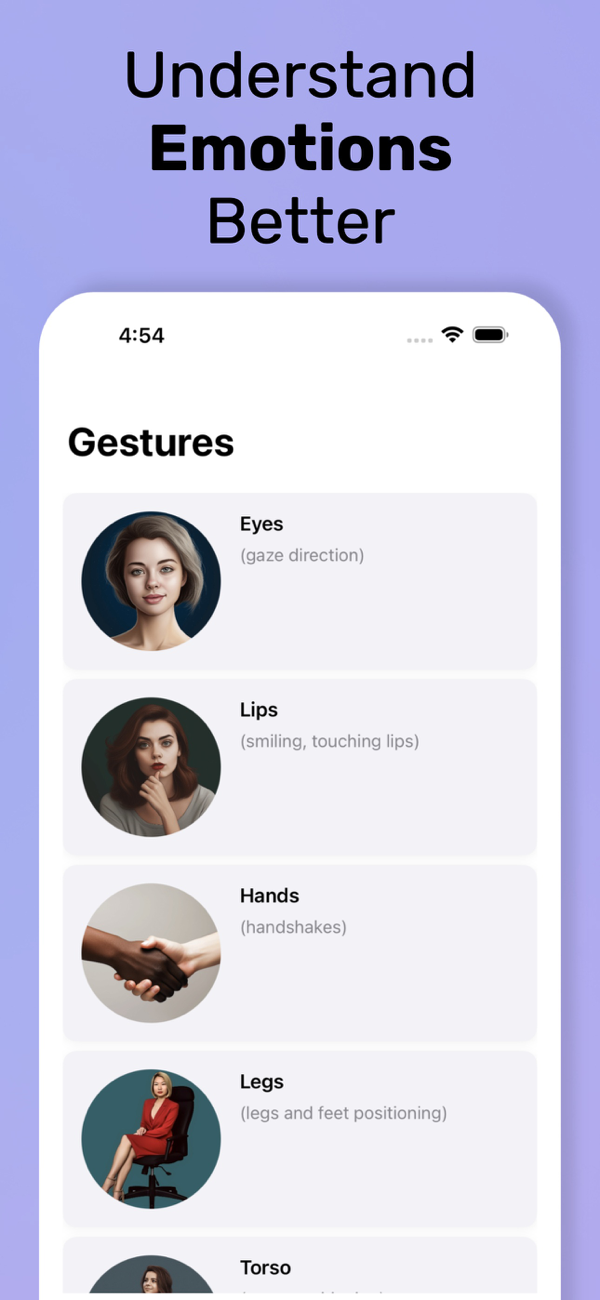
Once the rules are second nature, you decode signals area by area. This is exactly how the Psychology - Body Language app organises its lessons — Eyes, Lips, Hands, Legs and Torso — so you can learn one channel at a time.
The eyes
Eye contact signals interest and confidence; gaze aversion can mean discomfort or submission. Dilated pupils hint at genuine interest, and rapid blinking often flags stress. Full guide to eye-contact body language →
The face & microexpressions
The face broadcasts emotion faster than any other channel — sometimes in fleeting microexpressions that last a fraction of a second. Watch the brow, the eyes and the mouth together, and notice when a smile doesn't reach the eyes.
Hands & arms
Open palms suggest honesty and openness; hidden hands and crossed arms are closed, self-protective signals. Sudden stillness or a spike in self-touch (nose, neck, mouth) at a sensitive moment is worth noting.
Torso & posture
We lean toward what we like and angle away from what we don't. An open, squared-up torso means engagement; a turned or shielded torso signals withdrawal. Expansive posture reads as confidence; a collapsed, small posture reads as low status or anxiety.
Legs & feet
The feet are the most honest part of the body because we think about them least. Feet pointed toward you signal interest; feet pointed toward the exit signal a desire to leave, even while the face stays polite.
Putting it together in real conversations
In practice you're doing all of this at once: hold a baseline in mind, watch for clusters across several channels, weigh the context, and compare the body's message with the words. When they match, believe the words. When they clash, the body is usually telling the truth. Two common applications worth studying next: spotting deception and reading attraction.
Learn it with the app: from theory to instant recognition
Reading body language is a recognition skill — and recognition only gets fast with reps. That's what Psychology - Body Language is built for:
- Download the app free on the App Store.
- Work through the gesture library one body area at a time — Eyes, Lips, Hands, Legs, Torso — a few illustrated cues a day.
- Read the Expert Tip (how to use each cue in real life) and the Deep Science (why it happens) for every gesture.
- Take the interactive quizzes — you're shown a scenario and asked what it means, with instant feedback that burns it into memory.
- Start naming cues you see in real conversations. Recognition becomes automatic within a couple of weeks of daily practice.
Key takeaways
- Body language carries most of the emotional meaning in any conversation.
- Run every read through baseline → cluster → context.
- Decode area by area: eyes, face, hands/arms, torso, legs/feet.
- When words and body clash, trust the body.
- Speed comes from deliberate practice — study real cues, then quiz yourself.